 Stony Point, Albemarle County, Va. Oil on paper, 16 x 20.
These posts have been a little intense lately, so I could go for a change of pace. Perhaps something more on the order of a Facebook style of discourse – so –
Is it just me or has this been a great year for grapefruit?
* * * *
Today by way of recognizing the birthday of my late father-in-law, Sidney Everette Sutherland (1937–2002), I’d like to put in a word for the guy who wrote one of his favorite songs, “Joy To The World” (for Three Dog Night). There’s something about Hoyt Axton I always liked and I just think he and Mr. Sutherland would have gotten along very well, if only on the strength of the sentiments in that song. Mr. Sutherland’s parenting style is nicely suggested by the lines “Joy to the world/ All the boys and girls ... ”
In addition, any doubt you could possibly still have about the limits of Wikipedia can be erased by the third line of its piece on this song: “The words are nonsensical.”
Hoyt’s mother, Mae Axton, co-wrote Elvis Presley’s “Heartbreak Hotel” ... and another of Hoyt’s songs, “Greenback Dollar” (Kingston Trio), is a folk song with virtually a rock beat, and easy to play, so in the 1960s it rescued countless high school hootenannies just on the strength of pure energy.
* * * *
Ragged clouds seemed cold and threatening but in places overhead actually as thin as smoke – I could see blue behind them, dirty orange light inside. Fake bad weather – gray containment of light, a cold diffusion of light with the effect of making everything on the ground seem solid, sculptural, clear, super-real. Today I would have had no trouble mapping the position on the ground of everything between here and the woods. Massive trunks of nearby red oaks could have served as horizons in themselves.

;)
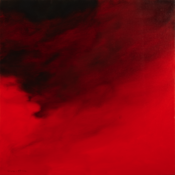

;) William Van Doren, GRAY (DISAMBIGUATION). Sunset from Stony Point, Albemarle County, Va. Oil on canvas, 18 x 24.
William Van Doren, GRAY (DISAMBIGUATION). Sunset from Stony Point, Albemarle County, Va. Oil on canvas, 18 x 24. Monday, September 15, 2014 at 05:39PM | by
;)
;)
;)
On the Origins of ‘Indian Summer’
Now we have Indian Summer, for maybe three days, starting yesterday. The closest thing to an official definition of this unofficial, undefined phenomenon is any autumn day over 70°F after the first frost. Sometimes this is supposed to mean the first killing frost, but lately I’ve been cheating and just any widespread frost will do.
You can read a lot of very interesting stuff about Indian Summer, presented in painfully uninteresting fashion, on the globalinterspiderweb, for example in the Wikipedia entry and in a USA Today piece borrowed, it seems, from a regional office of the U.S. Weather Service. The article by the Weather Service historian is particularly nice in its descriptions of Indian Summer.
It’s in trying to account for the term’s origins that these sources and others get a little strange. I can’t say that the sources are wrong, only that there’s a highly suspicious disconnect between the supposed etymology and the way the term is used – its sensual, emotional, even poetic connotations. I realize that such disconnects are common in etymology – a term often ends up meaning something completely divorced from its original context. But this is a case where other, better explanations are sitting right there at hand.
Maybe somehow, at some point, ‘Indian Summer’ really did have something to do with a period of the year when Indians were more likely to attack colonists, or colonists were likely to attack Indians (two of the leading theories). Maybe it really even derived from the ‘I.S.’ line marked on the outside of sailing ships – denoting the safe level to which one could load cargo for the Indian Ocean in the summer, i.e., Indian [Ocean] Summer [Level]. But somehow such explanations strike me as a triumph of mechanistic ‘history detective’ logic over common sense.
My theory, which isn’t all that theoretical, takes into account that, among the many terms for similar autumnal warm spells in other cultures, there’s also a ‘Gypsy Summer’, in southeastern Europe. I think the name must somehow be related to the mellow perfection of the weather and the sense of ease and well-being it tends to produce. At times like these, even you or I might be capable of living simply and directly, outdoors, like a native American or one of the Romani people. Not that I believe this exact thought is the source of the term, but it’s easy to associate such beneficent conditions with the people who live in the woods and fields. On an Indian Summer day, there’s no need for shelter from the rain, summer insects have been nipped by the frost, there’s neither the broiling heat of August nor the cold wet snow of February – it’s the kind of day when civilized or technological intervention is least needed and in fact only gets in the way.
Or I would put it like this: On a mild day in late October or early November, sit and face the sun, down out of the wind, in the tall dry grasses, your back against a line of trees. The sun turns you into a checkerboard of alternating squares of light and self. After a while you don’t know where you end and the sun begins. That’s because there is no such place. At that moment, any one of us is a true aboriginal of this splendid world.